Top 20 Real Assets & Infrastructure Advisory 2026

Review categories
- M&A Advisory Boutiques
- Capital Markets Advisory
- Corporate Tax Advisory
- Real Assets & Infrastructure Advisory
- Restructuring & Special Situations Advisory
- Private Capital Raising & Placement Advisory
- Structured Finance & Securitization Advisory
- Secondaries & Liquidity Solutions Advisory
Contact: [email protected]
Input
Modified
This report forms part of the Ranking News Investment Banking & Capital Markets Advisory series, which evaluates specialist advisory firms operating across real assets, infrastructure, energy transition, transport, digital infrastructure, and project finance markets.
Real assets and infrastructure advisory firms support investors, sponsors, corporates, and public-sector stakeholders in structuring, financing, acquiring, and divesting long-duration asset platforms. Their work often involves infrastructure M&A, concession assets, renewable energy projects, regulated utilities, transportation assets, digital infrastructure, and project finance transactions.
Unlike generalist investment banks, specialist infrastructure advisory firms typically combine transaction execution with sector-specific knowledge of regulation, concession structures, debt markets, institutional capital, and public-private investment frameworks.
Market Overview
The real assets and infrastructure advisory market continues to expand as institutional investors increase allocations to infrastructure, energy transition, logistics, data centers, utilities, transport, and other long-duration assets. Independent advisory firms are particularly relevant where projects require specialized knowledge of concession structures, project finance, regulation, and long-term capital formation.
Major advisory hubs remain concentrated in London, Paris, New York, Madrid, Zurich, and Singapore, reflecting the cross-border nature of infrastructure capital flows.
The market has also become more specialized as energy transition, digital infrastructure, and private infrastructure funds create demand for advisors who understand both financial structuring and asset-level operating complexity.
Industry Trend — 2026
In 2026, real assets and infrastructure advisory is increasingly shaped by three forces: energy transition, digital infrastructure expansion, and public-sector funding constraints. Renewable energy, grid modernization, battery storage, data centers, ports, airports, and transport assets continue to attract institutional capital.
Private capital is also playing a larger role in infrastructure development, particularly where governments seek private-sector participation through PPPs, concessions, or long-term operating agreements. Specialist advisors are therefore increasingly involved in both transaction structuring and capital formation.
The category remains commercially attractive because many firms in this sector compete for mandates from infrastructure funds, pension funds, sovereign investors, developers, and public-sector authorities.
Methodology — Core Eligibility Criteria
Firms considered for this ranking were evaluated based on the following criteria:
- Provides real assets, infrastructure, project finance, or energy transition advisory
- Advises on M&A, capital raising, debt structuring, PPPs, or project finance
- Demonstrates experience with infrastructure investors, sponsors, developers, or public-sector counterparties
- Maintains a specialist focus beyond generalist investment banking
- Operates in major real assets or infrastructure capital markets
Methodology — Ranking Factors
Firms included in the ranking were evaluated using qualitative institutional indicators including:
- Experience in infrastructure M&A and project finance
- Reputation among infrastructure funds, developers, and institutional investors
- Track record in energy, transport, digital infrastructure, and utilities
- Senior-level involvement in transaction execution
- Cross-border advisory capabilities
The ranking universe consisted of approximately 65 advisory platforms globally, from which 20 firms were selected.
Tier classification reflects relative institutional positioning within the category and does not constitute investment, legal, or voting advice.
Tier I — Leading Real Assets & Infrastructure Advisory Firms
Macquarie Capital
- Headquarters: Sydney, Australia
- Founded: 1969
Macquarie Capital is one of the most influential global platforms in infrastructure, energy, digital infrastructure, and real assets advisory. The firm operates across advisory, capital markets, development, and principal investment, giving it an unusually deep understanding of how infrastructure assets are financed, owned, developed, operated, and transacted.
Its infrastructure advisory work spans sectors such as transport, utilities, renewables, energy transition, digital infrastructure, social infrastructure, and other long-duration asset classes. Macquarie advises corporate clients, financial sponsors, developers, infrastructure funds, and institutional investors on M&A, capital raising, debt advisory, project development, and strategic transactions.
The firm’s scale makes it different from a classic advisory boutique, but that scale is also part of its category relevance. Infrastructure transactions often require sector knowledge, capital formation capability, lender relationships, public-sector familiarity, and long-term asset-level understanding. Macquarie’s infrastructure franchise combines these elements in a way that few firms can match.
Macquarie Capital fits Tier I because it represents the institutional benchmark for infrastructure advisory.
Rothschild & Co
- Headquarters: Paris, France
- Founded: 1811
Rothschild & Co is one of the most established global financial advisory firms, with a strong presence in infrastructure, power, renewables, energy, public-sector advisory, and real assets transactions. The firm advises infrastructure funds, corporates, governments, financial sponsors, and asset owners on M&A, privatizations, capital raising, restructurings, and strategic transactions involving regulated and long-duration assets.
Its real assets advisory work is particularly relevant in sectors such as transport, utilities, renewable energy, digital infrastructure, power generation, concessions, and public infrastructure. These transactions often require independent advice on valuation, regulatory exposure, concession structure, public-sector engagement, financing alternatives, and long-term strategic positioning.
Rothschild’s strength comes from combining sector expertise with global financial advisory capability. In infrastructure, where assets often sit between private capital, government policy, regulation, and public interest, the ability to advise across stakeholder groups is especially important.
Rothschild & Co fits Tier I because of its long-standing advisory reputation, global reach, and clear relevance to major infrastructure and real assets transactions.
Lazard
- Headquarters: New York, United States
- Founded: 1848
Lazard is a leading global financial advisory firm with significant experience across power, energy, infrastructure, utilities, sovereign advisory, and public-sector-related mandates. The firm advises governments, corporates, financial sponsors, infrastructure investors, and boards on strategic transactions involving capital-intensive and regulated assets.
Its infrastructure relevance comes from its work in M&A, capital structure, restructuring, privatizations, energy transition, and strategic advisory. Infrastructure and real assets transactions often involve long-term cash flows, regulatory exposure, public-policy considerations, and institutional capital formation. Lazard’s advisory model is well suited to these environments.
The firm is particularly credible in cross-border and public-sector-sensitive situations. Infrastructure transactions frequently involve government stakeholders, pension funds, sovereign wealth funds, regulated utilities, or nationally important assets. Lazard’s history in advising sovereigns and institutions gives it a strong position in these contexts.
Lazard fits Tier I because it remains one of the leading global advisory names with a recognizable power, energy, and infrastructure platform. It is broader than a pure infrastructure boutique, but its advisory-led model and infrastructure transaction experience make it a strong top-tier benchmark.
Evercore
- Headquarters: New York, United States
- Founded: 1995
Evercore has developed a strong infrastructure, utilities, renewables, and energy transition advisory capability within its broader independent investment banking platform. The firm advises companies, financial sponsors, infrastructure funds, pension funds, sovereign wealth funds, and institutional capital providers on strategic transactions involving long-duration real assets.
Its infrastructure work spans sectors such as transportation, digital and communications infrastructure, utilities, renewables, energy transition, waste, water, social infrastructure, healthcare infrastructure, and related asset platforms. These sectors require a combination of sector knowledge, valuation discipline, investor access, and board-level judgment.
Evercore’s senior-led advisory model is particularly relevant in complex infrastructure transactions where clients need independent advice rather than balance-sheet-driven financing. The firm’s role often involves strategic alternatives, M&A, capital structure, asset monetization, platform transactions, and high-value infrastructure mandates.
Evercore fits Tier I because it brings elite independent advisory credibility to the real assets and infrastructure transaction market. It is not as infrastructure-specialized as Macquarie or Astris, but its infrastructure advisory group is strong enough to justify top-tier placement.
Astris Finance
- Headquarters: Paris, France
- Founded: 2000
Astris Finance is a specialist infrastructure and energy transition investment banking advisory firm focused on M&A, project finance, capital raising, and long-term capital advisory. The firm works with developers, investors, infrastructure platforms, lenders, and asset owners across transportation, renewable energy, power systems, digital infrastructure, and social infrastructure.
Its value lies in its specialist infrastructure identity. Unlike broader investment banks where infrastructure is one sector among many, Astris has built its platform around infrastructure and energy transition transactions. This gives the firm a sharper category fit than many larger generalist advisory institutions.
Astris is particularly relevant for transactions involving renewable energy, concessions, transportation assets, distributed infrastructure, digital infrastructure, and project-financed assets. These transactions require detailed understanding of risk allocation, debt capacity, equity appetite, regulatory environment, and long-term asset economics.
Tier II — Established Real Assets & Infrastructure Advisory Firms
(Alphabetical order)
8 Advisory
- Headquarters: Paris, France
- Founded: 2009
8 Advisory provides infrastructure, energy, and project finance advisory services across transaction consulting, financial modelling, project finance, capital raising, and deal execution support. The firm advises clients in sectors including energy transition, transport, telecommunications, social infrastructure, utilities, and related infrastructure markets.
Its strength lies in technical transaction support. Infrastructure investors, developers, lenders, and sponsors often require detailed financial modelling, model audit, financing analysis, bid support, valuation review, and project finance structuring. 8 Advisory’s infrastructure and energy team is aligned with these needs.
The firm is particularly relevant for European infrastructure and energy-transition transactions where financial discipline, modelling reliability, and transaction execution support are critical. Its advisory platform is less globally dominant than Tier I firms, but more focused and potentially more relevant to licensing outreach.
8 Advisory fits Tier II because it is active, specialist enough, and commercially relevant. It provides a concrete infrastructure advisory profile without being merely an investment manager or vague strategy consultancy.
Agentis Capital
- Headquarters: Vancouver, Canada
- Founded: 2009
Agentis Capital is an independent financial advisory firm focused on infrastructure finance, project finance, M&A, greenfield project advisory, and related transaction support. The firm advises infrastructure investors, sponsors, developers, governments, lenders, rating agencies, and corporate clients across sectors such as transportation, power, airports, public-private partnerships, transmission assets, water, waste-to-value, renewables, and digital infrastructure.
Its advisory model is especially relevant for complex infrastructure projects where financing structure, risk allocation, lender coordination, and public-sector interface determine whether a transaction can close. Agentis has built a strong identity around infrastructure finance rather than broad corporate advisory.
The firm is also relevant because it works across both brownfield and greenfield infrastructure. Greenfield advisory requires more than valuation and M&A capability; it requires understanding development risk, procurement structure, construction interface, concession design, and bankability.
Agentis Capital fits Tier II because it combines specialist infrastructure finance capability with visible operational presence.
DC Advisory
- Headquarters: London, United Kingdom
- Founded: 1998
DC Advisory provides infrastructure and real assets advisory through its broader international corporate finance and M&A platform. The firm advises corporates, infrastructure investors, private equity clients, and financial sponsors on transactions involving energy, transport, utilities, communications infrastructure, and related asset-heavy sectors.
Its strongest fit is in mid-market and cross-border infrastructure transactions where sector knowledge, financial sponsor access, and disciplined execution matter. DC Advisory’s infrastructure group has enough visibility and sector specialization to justify inclusion in this category, especially for infrastructure M&A and strategic transaction advisory.
That said, DC Advisory should remain in Tier II rather than Tier I. It is a credible infrastructure advisor, but the firm’s overall identity is broader corporate finance and M&A advisory, not infrastructure-first advisory. Tier I should be reserved for firms whose infrastructure franchise is globally dominant or deeply defining to the platform.
DC Advisory fits Tier II because it is active, recognizable, and commercially relevant, while not quite matching the infrastructure authority of Macquarie, Rothschild, Lazard, Evercore, or Astris.
Green Giraffe Advisory
- Headquarters: Paris, France
- Founded: 2010
Green Giraffe Advisory is a specialist financial advisory firm focused on renewable energy, energy transition, project finance, debt structuring, equity raising, M&A, and infrastructure-related transactions. The firm advises developers, investors, lenders, utilities, and energy-transition platforms on complex financing and transaction processes.
Its advisory work is particularly relevant in wind, solar, energy storage, hydrogen, grid-related projects, and other renewable infrastructure assets. These sectors require deep understanding of revenue models, construction risk, offtake structures, policy support, grid access, lender appetite, and long-term investment economics.
Green Giraffe’s positioning is narrower than a general infrastructure advisor, but that specialization is valuable. Energy transition has become one of the largest and most active subfields within real assets advisory, and renewable infrastructure finance is now central to the infrastructure investment market.
Green Giraffe fits Tier II because it is a clear specialist platform with strong category relevance. It could even be argued as a Tier I specialist in energy transition, but for a broader real assets and infrastructure ranking, Tier II is a more balanced placement.
Gridlines
- Headquarters: London, United Kingdom
- Founded: 2021
Gridlines is an independent project finance advisory, financial modelling, and infrastructure finance specialist focused on complex energy transition and infrastructure projects. The firm supports developers, sponsors, investors, lenders, and public-sector counterparties in financial modelling, bid support, financial advisory, model audit, and project finance execution.
Its relevance comes from the practical mechanics of infrastructure finance. Large infrastructure and energy projects often depend on robust financial models, debt structuring, lender engagement, sensitivity analysis, and bid-stage decision support. Gridlines is positioned around precisely these execution needs.
The firm’s growth reflects the increasing demand for senior-led, agile project finance support in an infrastructure market where timelines are compressed and modelling complexity is rising. Its work across energy, transport, social infrastructure, and digital infrastructure gives it a wider remit than a narrow modelling-only provider.
Gridlines fits Tier II because it is active, specialist, and clearly aligned with infrastructure transaction execution. It is younger than several peers, but its focused positioning gives the industry a more current infrastructure finance profile.
Operis
- Headquarters: London, United Kingdom
- Founded: 1990
Operis is an independent project finance advisory and financial modelling firm with a long-standing presence in infrastructure, energy transition, digital infrastructure, and non-recourse financed projects. The firm provides financial advisory, model audit, tax, accounting, training, and financial modelling support for project-financed assets.
Its advisory relevance lies in infrastructure execution. Project finance transactions are highly sensitive to model quality, risk allocation, debt sizing, tax treatment, covenant structure, and lender confidence. Operis supports clients in structuring and reviewing these elements, making it important in transactions where technical financial discipline matters.
The firm is particularly relevant for sponsors, lenders, developers, public-sector entities, and investors involved in PPPs, renewable energy, digital infrastructure, transport, and social infrastructure. Its long operating history gives it credibility as a specialist rather than an opportunistic recent entrant.
Operis fits Tier II because it is one of the cleaner specialist infrastructure finance advisory firms. It may not have the brand scale of Tier I institutions, but its technical relevance to infrastructure transactions is strong.
Rubicon Capital Advisors
- Headquarters: Dublin, Ireland
- Founded: 2011
Rubicon Capital Advisors is a global investment advisory firm focused on infrastructure, energy transition, digital infrastructure, utilities, transportation, social infrastructure, environmental assets, and related sectors. The firm advises clients on M&A, capital raising, divestitures, acquisition advisory, debt procurement, refinancing, restructuring, asset monetization, and strategic capital solutions.
Its infrastructure focus is broad enough to cover multiple real asset categories, but still concentrated enough to avoid looking like a generic investment bank. Rubicon’s work is particularly relevant where infrastructure assets require sector-specific M&A advice, investor engagement, long-term capital structuring, and cross-border execution.
The firm’s positioning is useful for this ranking because it sits between the global advisory banks and smaller project finance boutiques. It has a visible infrastructure identity, international footprint, and a transaction-oriented service model.
Rubicon Capital Advisors fits Tier II because it is active, identifiable, and directly aligned with the transaction side of real assets advisory. It is broader than a narrow modelling firm but still clearly infrastructure-focused.
Steer
- Headquarters: London, United Kingdom
- Founded: 1978
Steer is a global consultancy focused on transport, cities, infrastructure, energy, economics, commercial advisory, and technical advisory. The firm advises public and private clients on transport systems, mobility, infrastructure investment, financial appraisal, demand forecasting, policy, strategy, and project development.
Its relevance to this ranking comes from the non-bank side of infrastructure advisory. Not every real assets advisory mandate is an M&A or project finance mandate. Many infrastructure decisions require demand analysis, technical assessment, commercial feasibility, policy understanding, procurement strategy, and public-sector interface.
Steer is particularly strong in transport and mobility, but its infrastructure advisory capabilities extend into broader city, energy, and critical infrastructure questions. Its consulting profile gives the industry a useful complement to the financial advisory boutiques.
Steer fits Tier II because it is active, established, and highly relevant to real assets and infrastructure advisory. It should be framed as an infrastructure consultancy rather than an investment banking boutique.
ValeCap
- Headquarters: Milan, Italy
- Founded: 2009
ValeCap is an independent investment banking boutique focused on energy and infrastructure transactions. The firm advises investment funds, industrial companies, developers, and infrastructure clients on M&A, debt transactions, capital structure, renewable energy, and infrastructure-related transactions.
Its advisory work is closely aligned with the energy transition and infrastructure investment market. European infrastructure clients often need specialist support in debt structuring, transaction execution, investor engagement, and strategic capital decisions. ValeCap’s boutique profile makes it relevant for these situations.
The firm is narrower and less globally visible than several Tier II peers, but it has a clear sector identity. In an ecosystem that avoids vague or lightly traceable firms, ValeCap is preferable to generic advisory names because its infrastructure and energy positioning is concrete.
ValeCap fits Tier II because it combines sector focus, M&A capability, and debt transaction experience in a clearly defined energy and infrastructure advisory platform.
Voltiq
- Headquarters: Amsterdam, Netherlands
- Founded: 2009
Voltiq is a specialist financial advisory firm focused on renewable energy and energy transition infrastructure. The firm advises clients on M&A, project finance, debt financing, equity raising, and financial structuring for renewable energy companies, developers, investors, and infrastructure platforms.
Its work spans technologies such as solar, onshore wind, offshore wind, hydropower, biomethane, battery storage, and broader energy-transition assets. These sectors require specialized understanding of policy frameworks, merchant risk, long-term offtake, project bankability, construction risk, grid connection, and investor appetite.
Voltiq’s narrow focus is a strength rather than a weakness. Energy transition infrastructure is one of the most active areas of real assets investment, and specialist advisors that understand both project finance and renewable asset economics are highly relevant.
Voltiq fits Tier II because it is focused, active, and identifiable, with a strong renewable infrastructure profile. It adds a credible energy-transition finance advisor to the industry without relying on a large generalist platform.
Tier III — Specialist Real Assets & Infrastructure Advisory Firms
(Alphabetical order)
Alhambra Infrastructure Advisors
- Headquarters: Madrid, Spain
- Founded: 2023
Alhambra Infrastructure Advisors is a specialist infrastructure and transportation strategy consulting boutique focused on transport, logistics, real estate-related infrastructure, and social infrastructure. The firm advises public-sector clients, infrastructure operators, developers, investors, and corporations on strategic infrastructure projects and asset development.
Its work is especially relevant in transportation and mobility-related infrastructure, including aviation, ports, maritime, railways, roads, urban mobility, logistics, supply chains, and social infrastructure. This gives Alhambra a clearer sector identity than generic strategy consulting firms.
Alhambra is better placed in Tier III than Tier II because it is more strategy and infrastructure-development oriented than transaction-finance oriented, and its current platform appears newer than the more established Tier II advisory firms. However, its infrastructure focus is still useful for the ranking.
Alhambra fits Tier III because it adds a specialist transportation and infrastructure strategy angle. It should be positioned as an infrastructure strategy consultancy rather than a core financial advisory boutique.
Bedrock Infrastructure Advisory
- Headquarters: Coral Gables, United States
- Founded: 2020
Bedrock Infrastructure Advisory is a specialist consulting firm focused on procurement, structuring, project finance, and public-private partnership advisory for infrastructure projects and transactions. The firm assists private and government clients, particularly across the United States, Latin America, and the Caribbean.
Its relevance lies in PPP and P3 infrastructure delivery. Many real assets advisory mandates involve more than capital raising; they require procurement design, concession structuring, risk allocation, public-sector negotiation, and practical project delivery support. Bedrock’s focus is directly aligned with those needs.
The firm is smaller and less globally visible than the Tier II platforms, but its advisory identity is concrete. It is not an investment manager or loosely connected consulting label; it is specifically positioned around infrastructure procurement and structuring advisory.
Bedrock Infrastructure Advisory fits Tier III because it is a specialist PPP and infrastructure transaction-support boutique. It adds a useful public-private infrastructure layer to the industry.
P3 Collaborative
- Headquarters: Princeton, United States
- Founded: 2009
P3 Collaborative is an infrastructure development advisory firm focused on public-private partnerships, alternative project delivery, value planning, negotiation, dispute resolution, and infrastructure project development. The firm works across water, transport, buildings, energy, resilience, adaptation, and transit-oriented development.
Its relevance comes from the development and delivery side of real assets advisory. Many infrastructure projects fail not because capital is unavailable, but because stakeholder alignment, procurement strategy, project scope, delivery model, and public-sector decision processes are poorly structured. P3 Collaborative addresses this project-development layer.
The firm is more specialized and less finance-heavy than the Tier II firms, but this makes it useful as a Tier III inclusion. It broadens the ranking beyond investment banking and energy-transition finance into the practical mechanics of public infrastructure delivery.
P3 Collaborative fits Tier III because it is active, focused, and directly connected to PPP infrastructure advisory. It should be positioned as a project-development and alternative-delivery advisor rather than a broad capital markets advisor.
Rebel Group
- Headquarters: Rotterdam, Netherlands
- Founded: 2002
Rebel Group is an infrastructure, PPP, strategy, finance, and public-private advisory firm operating at the intersection of public-sector needs and private-sector capital. The firm advises clients on infrastructure development, public-private partnerships, innovative financing, project delivery, mobility, renewable energy, housing, social infrastructure, and local regeneration.
Its relevance lies in helping public and private clients bridge the gap between infrastructure needs and financial resources. This is particularly important in markets where public authorities require private capital, innovative procurement structures, and commercially realistic delivery models to bring infrastructure projects forward.
Rebel’s advisory model is broader than pure financial advisory, but still clearly infrastructure-focused. It combines strategy, finance, project development, public-sector understanding, and implementation-oriented advice.
Rebel Group fits Tier III because it is active, specialist, and differentiated. It adds a public-private strategy and infrastructure development dimension that is not captured by investment banks or renewable energy finance boutiques alone.
Infrata
- Headquarters: London, United Kingdom
- Founded: 2011
Infrata is a global infrastructure advisory firm providing technical, demand, commercial, and sustainability advice on infrastructure projects and transactions. The firm supports public and private clients, lenders, investors, and sponsors across transport, energy, social infrastructure, water, power, digital infrastructure, and related sectors.
Its advisory role is especially relevant in due diligence and project assessment. Infrastructure investors often need independent views on traffic demand, technical feasibility, commercial assumptions, operational performance, sustainability implications, and asset risk before committing capital.
Infrata is now part of a broader consulting platform, so it may be less attractive as a licensing target than independent boutiques. However, its infrastructure advisory identity remains clear and its technical relevance is strong.
Infrata fits Tier III because it adds a technical and demand-advisory layer to the ranking. It should not be treated as a pure financial advisor, but it is highly relevant to real assets and infrastructure transaction assessment.
Project Finance Advisory Ltd. — PFAL
- Headquarters: Los Angeles, United States
- Founded: 2008
Project Finance Advisory Ltd. is a specialist advisory firm focused on helping governments optimize, finance, and deliver large-scale infrastructure and real estate projects. The firm provides strategic and tactical advice on project finance, infrastructure delivery, and public-sector capital structuring.
Its relevance comes from the government-side advisory perspective. Infrastructure advisory is not only about advising investors and sponsors; public authorities also need support in structuring bankable projects, evaluating procurement models, attracting private capital, and designing delivery frameworks that balance public value with investor requirements.
PFAL’s profile is narrower than Tier II transaction boutiques, but it is directly aligned with infrastructure finance and project delivery. This makes it a useful specialist candidate for the lower tier.
PFAL fits Tier III because it is focused, advisory-led, and relevant to public infrastructure finance. It is operating in another orthogonal angle: government-facing infrastructure finance advisory rather than sponsor-side investment banking.
Remarks
Real assets and infrastructure advisory is one of the more useful categories in the capital markets advisory sector because it has a genuinely distinct firm universe. Unlike generic capital markets advisory, this category can support a recognizable buyer pool: infrastructure boutiques, project finance advisors, energy transition specialists, and real assets transaction advisors.
The category should not be split further into “real estate advisory,” “infrastructure advisory,” “energy advisory,” and “project finance advisory” at this stage. That would create unnecessary overlap and dilute the commercial value of the ranking.
Tier classification reflects relative institutional positioning within the corporate governance advisory landscape and does not constitute legal, investment, or voting advice.
Recognition
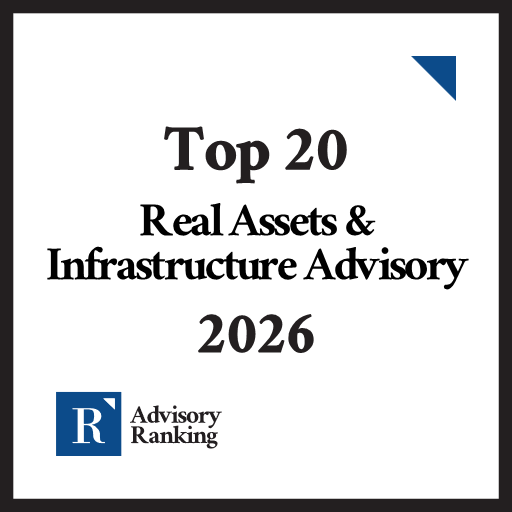
Organizations included in the Ranking News Top 20 Real Assets & Infrastructure Advisory 2026 ranking may request information regarding authorized use of the Ranking News designation for marketing and communications purposes.
Recognized institutions may reference the designation in:
- corporate websites
- investor communications
- marketing materials
- client presentations
Ranking inclusion is editorially determined and independent of licensing, advertising, or commercial participation. Recognition-materials licenses govern only the use of official Ranking News / Advisory Ranking assets, approved wording, and related communications materials.
Licensing inquiries:
[email protected]

Review categories
- M&A Advisory Boutiques
- Capital Markets Advisory
- Corporate Tax Advisory
- Real Assets & Infrastructure Advisory
- Restructuring & Special Situations Advisory
- Private Capital Raising & Placement Advisory
- Structured Finance & Securitization Advisory
- Secondaries & Liquidity Solutions Advisory
Contact: [email protected]
Similar Post